Showing posts with label Hawke's Bay. Show all posts

Tuesday, 17 April 2012

Up to the Bay of Islands

It's with a heavy heart that we have to leave Hawke's Bay to find some work up in the Bay of Islands, in time for the start of the kiwifruit picking season, which runs from April to June. Napier has been our home for the last 5 weeks, and there have a lot of highs and thankfully only a few lows.

We've met some brilliant people at our hostel, Archie's Bunker (the same hostel we stayed at on our original trip!) and we even managed to find some temporary work, although the whole apple picking fiasco was the only sour point of our stay. It eventually turned out that despite what you're told, employees are entitled to the minimum wage in New Zealand even on piece rates and if you don't get this then your employer is breaking the law.

For the last three weeks I've been working for Judd Dougan Team Architects (originally Natusch and Sons), one of the original members of the Associated Architects in Napier who were the principals of the four major architecture practices. It provided an interesting insight into the architecture industry in New Zealand, which isn't dissimilar to the UK in that there has been quite a slow down in the last couple of years, but it's showing signs of recovery from the global recession.

One of the last things we did on our final weekend in Hawke's Bay was to scale Te Mata peak, located a short distance from Napier (25 km away) on the outskirts of Havelock North. Legend tells us that the ridge is meant to be the body of the Māori chief, Rongokako, lying down after having choked on a rock as he tried to eat his way through the hill. At the very top of the peak you can get beautiful panoramic views across the Heretaunga Plains - on a clear day it's supposedly possible to see Mt Ruapehu in the heart of Tongariro National Park.

Lizzie in front of the 399m high limestone bluffs


View looking back to Napier


Hopefully we'll be back in Napier before too long, but for now Kerikeri is our ultimate destination as we head up to the most northern region of the North Island to check out the much touted Bay of Islands. Famous for its sub-tropical weather and beautiful blue waters with around 150 islands punctuated throughout, the area also holds enormous historical significance for the Māori as well as the first Europeans who settled here, when the British started colonising Aotearoa or New Zealand as it's now known.

Driving north of Napier along the Thermal Explorer Highway (State Highway 5) where we stopped off in Rotorua via Taupo to see some familiar sites at Kuirau Park (a public park with lots of geothermal activity) and down by Lake Rotorua - the second largest lake on the North Island.

Continuing along State Highway 5, we eventually stopped off at Hamilton to break up the journey and spend the night there, although I can't say I was impressed by the small part of Hamilton we saw and I don't think we'll bother making a return trip!

Kuirau Park is a good place to see free geothermal activity in Rotorua


The next day we left early to drive up the motorway through Auckland, as it was still another 5 hours to Kerikeri. Taking a brief detour to avoid the Northern Gateway Toll Road, we briefly joined the Hibiscus Coast Highway where we stopped off in Orewa for lunch. From there we drove State Highway 1 all the way up to Kerikeri for roughly 210 kms.

The place we're staying at is on the outskirts of the town, called Kerikeri Farm Hostel. It's an animal lovers paradise so Lizzie feels very much at home! There are two dogs at the hostel, a one year old Labrador called Nika - she's a lovely dog who's very excitable but also likes to jump up at you and chew your hand if she gets too carried away! There's also another dog called Weewee who is a little older and very affectionate, although she's a little overweight and is currently on a diet. Apparently, there's an elusive cat around called Mr Stink, however he's quite shy and we haven't seen him yet.

Throw Nika a stick and she'll be your new best friend

Weewee loves her back being scratched!


The farm hostel also has two female kunekune pigs (which means 'fat and round' in Māori), a sheep called "Fluffy" and a whole host of free range chickens, which are quite tame and friendly.

These were once cute little piglets. Oink oink!

The cockerel is a reliable morning alarm clock


This chicken wouldn't look out of place in the film Tron!


Exploring the local area we ventured 2 km from town down to the Kerikeri Basin, which was the site chosen by Samual Marsden for the Church Missionary Society's second mission in New Zealand. The site is home to New Zealand's oldest standing European buildings - the Stone Store and  Kerikeri Mission House (Kemp House). The Stone Store is the oldest surviving stone building in New Zealand and was constructed in 1836 - it kind of reminds me of the old wool mill buildings back at home in Witney, Oxfordshire. The store served as a central provision store for the Church Missionary Society. Nearby is Kemp House, which is New Zealand's oldest European building constructed between 1820-21. Although, it's less than 200 years old, Kemp House still pre-dates the signing of the Treaty of Waitangi (New Zealand's founding document) by almost 20 years.

The old Stone Store across the Kerikeri River


More info about what the store was used for can be found inside


Opposite the Kerikeri Basin Reserve is the start of a walk along the Kerikeri River to Wharepuke Falls, where we got an awesome view of a Sacred Kingfisher (Todiramphus sanctus).

A Pukeko (New Zealand Swamp Hen) on the opposite side of the river

The Kingfisher is also known by its Māori name, Kōtare 


Wharepuke Falls are a 20 minute walk from the Stone Store 


The track follows the north bank of the river, passing through some kiwi habitat and regenerating native trees such as kauri and tōtara. Further up the river are Rainbow Falls (or Waianiwaniwa, which in Māori means "Waters of the Rainbow"), which are 27m high. There's a decent lookout from the top and the falls certainly lived up to their name as there were lots of rainbows created by all the mist in the air. It's possible to walk to the base of the falls but you are guaranteed to get a little damp from all the water vapour drifting in the air!


A rainbow formed from the spray of Rainbow Falls


There's no safety barriers to stop you falling in if you get too close!

Sunday, 1 April 2012

Easy pickings? Things to consider when fruit picking

Quite a lot of people we've meet in New Zealand have been travelling on some form of working holiday visa, which can range from 12 to 23 months in length, however, you can only work for a total of 12 months. The quickest and most obvious way of earning some money is by doing some seasonal work such as working on an orchard somewhere on the North Island, notably in the Bay of Islands, Bay of Plenty or Hawke's Bay. But is it really that easy to casually make a quick buck to help fund your travels?

I decided to write the following post based on my own experiences when I went to work at the Tollemache Orchards in Hastings for local contractors M.V.T. Services Ltd - run by business owners, Mike and Heinnie. I wish I had lots of positive things to write about my brief time working as an apple picker, but it certainly gave me a better insight into some of the questionable working practices of contractors.

There are lots of stories about how it's possible to earn couple of hundred dollars a day picking fruit, but the reality is that this isn't achievable in the short-term and you'll only ever get to that level of earning if you've worked up to it long enough. Realistically you're looking at weeks or maybe months before you can adjust to that level of skill and endurance.

Also, more importantly you need to know what you're being paid and that you're being paid correctly. EVERYONE is entitled to the minimum wage, I've verified this with the Department of Labour so even if you're being paid on piece rates (i.e. per bin of fruit collected) you're still entitled to the minimum wage. According to the New Zealand Department of Labour:

"For employees on piece rates - for example, workers who get so many cents a kilogram for fruit picked, or so many dollars per garment produced - the total amount earned still can't be less than the minimum wage."

This somewhat contradicts what I was being told by Mike at M.V.T. Services Ltd, who informed me that I wouldn't getting the minimum wage, as I was contracted on a bin rate and it had been worked out by someone (but by who?) that the average worker could pick three bins of apples a day. Going on the bin rate that we were being paid ($30 per bin) in order to achieve the minimum wage for an 8 and ½ hour day we would need to pick four bins, which would earn you a total of $120 for the day, whereas on the minimum wage ($13.50 per hour, as of 1stApril 2012) you should earn $114.75 for the same the number of hours.

The purpose of the minimum wage is to protect those who can't consistently pick 4 bins of apples a day and to prevent them from being exploited. However, this doesn't mean you can take the piss and do the bare minimum, as the employer would be well within their rights to ask you to leave if you're not being productive enough. If you can pick more than four bins worth of apples in a day then the bin rate is great, but from speaking to other backpackers this is generally the exception not the rule.

When you sit down and do the maths, the figures don't look great for the reward of your hard work. If you can pick two bins of apples per day at $30 per bin (bearing in mind that it took me three and a half hours to pick one bin), then for a day's work you'll be earning well below than the minimum wage if your employer refuses to comply with law and make your wages up to minimum pay. As mentioned before, to earn the minimum wage for an 8 and ½ hour day you would need to pick 4 bins worth of apples. I would consider myself a reasonably fit young person who isn't shy to do a day's hard work, but I could safely say that I wouldn't be earning the minimum wage for some considerable time. On the whole, I was largely made to feel expendable by the contractor when I made this point as I was told that there were any number of backpackers willing to take my job if I didn't like the situation.

Let's look at the rough economics of how a commercial orchard generates its money. Fruit is sold in the supermarket on a weight basis, per kilogram. For example, one kilogram of Gala apples will cost approx. $3.50 and one kilogram of plums will roughly cost $5.00. A full bin of apples weighs approximately 300kg. In a hypothetical situation, if the supermarket pays the orchard owner $2.00 per kilo to make some profit on what they sell in-store, the orchard owner will still make $600 per bin. Granted not all the fruit in the bins will be of the best quality and there will be some considerable wastage which is sorted in the packing house. But it makes you think how little you're getting for what can be very hard and physical work. Be warned that this is massively over simplified as there are other stages to consider in the process including the investment made on managing the trees before they bear any fruit, as well as the work done in the pack house, etc., but it definitely gives some food for thought.

This was an apple bin that I picked just over two thirds full


If I can offer some small pearls of wisdom before you decide to take up a seasonal job such fruit picking, then the first thing you should consider is whether you're suited for this type of work. If you've never had a job before or you're not normally inclined to do manual work but are looking for a quick source of money, a fruit picking job probably won't be for you as you'll end up quite frustrated and begrudge the lack of earnings. The higher bin rates seen advertised often involve picking the fruit later in the season but there is less to pick so will you have fewer bins to show for you efforts.

However, if you do still want to be a fruit picker, then try and get signed up early with a couple of orchards, at least 2-3 weeks before the fruit picking season starts as there will be plenty of other people in the same position looking for jobs. Most orchards will require you to work 6 day weeks as seasonal work can only be between 8-12 weeks. So find out what days you're likely to be working as you will be expected to work every day you're asked. Also, for picking apples and kiwi fruits this is weather dependent, so if you don't get a good run of weather (like what has happened this season), you're earning potential will be lower than estimated.

Some hostels will try and arrange work for you, this is fine if you plan to stay at the hostel for the duration of your employment. But if you decided to move on elsewhere but want to stay working at the same orchard you might be asked to leave by the employer due to the arrangements they have with the hostels who find them workers at often short notice. Also, if possible try to avoid working for contractors, my experience was that once I was dealing directly with the orchard owner you can build up a rapport and they would be open to flexible work arrangements.

Most important of all is know what your rights are. Just because you're a backpacker in a foreign country doesn't mean that you should be taken advantage of. If you feel that you're not receiving the minimum wage you should report this to the Department of Labour who have a free phone number (0800 20 90 20) and get some advice. Although, I get the impression that this is common practice with fruit picking, it is against the law. You should get some contact details for your employer including the business name and number, plus if possible a contact name, number and address (this should at least be on your contract - if not ask).

The intention of the post isn't to deter anyone from doing seasonal work but to give people a better understanding of what they're letting themselves in for. Seasonal work can be a great way to meet new people especially as you will be in the same situation and can share experiences associated with the role. If anything, it should also be used as an opportunity (without trying to sound like a cliché) to expand your horizons.

Thursday, 29 March 2012

In and around Hawke's Bay: Hastings

Located 20km south of Napier is the town of Hastings, which is the commercial hub of Hawke's Bay. The district has a long history as a food producing region and it and is commonly referred to as the "Fruit Bowl of New Zealand", in particular for its strong associations with growing stone fruits and wine production.

Although it's the bigger brother to Napier, Hastings also shares a rich architectural heritage as much of it was also devastated by the 1931 Hawke's Bay earthquake. Whilst it didn't sustain quite the same level of devastation inflicted on its twin city, Hastings was also rebuilt to reflect the styles of the times - Stripped Classical, Spanish Mission and Art Deco. Where Art Deco is king in Napier, Spanish Mission has the upper hand in Hastings. In particular, the Westerman's Building (1932) is considered one of the best Spanish Mission style buildings in Hawke's Bay, rivalling that of the Criterion Hotel.

The magnificent Westerman's Building is home to the visitor centre

Decorative leadlights under the verandah


Picking up a couple of leaflets from i-SITE we decided to do some self-guided walks to explore the Central Business District. The most obvious building to begin with is the Clock Tower (1935), which towers over the city square. Art Deco in style, the tower was designed by young local architect Sydney Chaplin, who won a national design competition in 1934. The main Post Office with its clock tower was one of the main buildings to be destroyed  in the 1931 earthquake, so as part of the reconstruction efforts, a new clock tower was identified as one of the priorities. The Clock Tower is one of many buildings in Hastings registered with the New Zealand Historic Places Trust and serves as both a landmark and as a memorial to the 93 Hastings's residents who died in the earthquake.


On the edge of the city square is the Haukanui water feature, which is described as a point which serves as a link between the east and west ends of Hastings. Haukanui means "life giving waters" and apparently the feature symbolises the abundant natural water resource of the local aquifer system. However, I can't say that I've been to too many places where freight trains run through the middle of a fountain!

A picture of calmness and serenity at the Hastings city square...

... is shattered by a filthy, great big freight train


Walking west of the railway line we walked past some notable buildings including the Heretauga Club (1936), Medical and Dental Chambers (1935), Villa d' Este (1929) and Roach's Department Store (1934), among other buildings of interest.

The initials of the Heretauga Club can be seen on the exterior

The streamline Medical and Dental Chambers has curved walls projecting from the façade at each end
The most distinctive feature is the triangle-shaped window projecting  above the entrance
Villa d'Este on Heretaunga Street
The former Roach's Department Store
The Russell Street precinct has some of the most stunning Spanish Mission style buildings in Hastings, such as the CML (1939), Harvey's (1933) and Fitzpatrick's (1924) buildings. The CML Building was the last significant pre-World War II heritage building constructed in Hastings.

The Colonial Mutual Life (CML) Assurance Building is an eclectic mix of Art Deco, Spanish Mission and Stripped Classical styles
Decorative motifs of Maori origin are an unusual feature in the archway
The Harvey's Building is currently home to the Hastings Community Art Centre and inside there is an impressive leadlight skylight which fills the gallery with natural light.

The Spanish Mission Harvey's Building on Russell Street
The impressive leadlight design above the main gallery


Green Celtic knots can be seen in the design on the pilasters of the Fitzpatrick's Building
The Hastings Post Office was originally built in 1910 and extended in 1928. However, only the extension survived the earthquake. This was incorporated in a new Stripped Classical building designed by J.T. Muir who also designed the Former Government Buildings in Napier.

The former Hastings Post Office is one of the best known and historically important buildings in Hastings
The Stripped Classical design has subtle ionic decoration

The Former Government Buildings in Napier
The cream of crop of Hastings' heritage buildings is the Hastings Municipal Theatre (1915) which forms part of the Hawke's Bay Opera House. This was the first Spanish Mission building façade to be completed in Hastings. While the building survived the earthquake, extensive repairs and strengthening were required. Adjoining the Municipal Theatre is the Muncipal Building and Assembly Hall (1917). The building was designed by local architect Albert Garnett who won a design competition, which neighbouring Napier architects banned from entering. He drew on an eclectic blend of visual styles to design a Renaissance-style building for the Hastings Borough Council's administration staff.

The Municipal Theatre is one of the last remaining theatres in New Zealand built by the eminent Australasian theatre designer Henry Eli White
The leadlight glass at the Hastings St side entrance is Art Nouveau in style
In 2004, the District Council commissioned the restoration of these two heritage buildings and a new third building comprising of a foyer and plaza linking the Opera House to the existing historical buildings.

The Municipal Buildings also house Hawke's Bay's largest ballroom as part of the Opera House complex


Opposite the Opera House is the Wesley Methodist Church (1932) which completes this iconic part of Hastings. This Spanish Mission style church was designed to replace the original, which was destroyed by the 1931 earthquake. The redeveloped site contains stone seats and a low perimeter stone wall, which are constructed from the concrete rubble recovered from the original Methodist church.

Wesley Methodist Church is set across the road from the Opera House
The outside of the church has been painted in colours to complement the Opera House
Finally, the Dominion Restaurant (1935) on Heretaunga Street is the only remaining asymmetrical shop front design in Hastings. Although Hastings was predominately rebuilt in the Spanish Mission style architecture, this is most definitely Art Deco!

The Dominion Restaurant was designed by the prominent the architecture practice Edmund Anscombe and Associates.
Although, we enjoyed doing our own tour round Hastings it definitely felt more rough around the edges than Napier, especially with all the boy racers. I would recommend it as good day trip if you're looking for some more unique architecture. Hastings was less than an hour away from Napier on the bus, which is considered a good connection if your using public transport in the more remote parts of New Zealand.

Wednesday, 21 March 2012

Cheerio to Deco

It's the final day of the Art Deco Weekend and the proceedings are starting to wind down for this year's celebrations. However, there's still plenty on offer to round off the biggest event in the Hawke's Bay calendar.

To start off the day we walked round the corner of our hostel to the Masonic Hotel, as this was the starting line for the Soap Box Derby. This is an annual event where home-made carts race down Tennyson St for personal glory! There was a whole variety of racers including a wine bottle shaped cart, a steam engine (with liquid nitrogen steam), Brum from the children's TV series, Gertie the Truck, an army Jeep, plus many other streamlined racers. It was all done in good spirit and the event drew in a huge crowd who lined both sides of Tennyson St - it kind of reminded me of the episode of The Simpsons, Saturdays of Thunder with a similar Soap Box Derby race. There was even a parade at the end for all the racers to showcase their home-made efforts.


It's a fine line between success and failure!

This soap box racer was so fast it was just a mere blur!


Moving on to the next scheduled event of the day, we headed over to the Colonnade for the Veronica Bell Parade. At the Veronica Sunbay, the bell from the HMS Veronica is installed with a fully military ceremony to commemorate the efforts of the navy during the 1931 Hawke's Bay earthquake. This was an especially poignant reminder in light of the first anniversary of the Christchurch earthquake. The bell is rung to herald the conclusion of the Art Deco Weekend and is guarded by the Sea Scouts until it is taken to Waiapu Anglican Cathedral later on during the day.


The bell from HMS Veronica hanging from the Sunbay


Outside the i-SITE visitor centre, the Hawke's Bay Vintage Car Club were collecting donations in exchange for a car ride. It would have been rude not have taken up the opportunity so we took a short ride down the Marine Parade in a luxury Packard. Lizzie got to ride shotgun whilst I had the back all to myself. It was a smooth ride with the wind in your face and the driver called his Packard "an American Rolls Royce" and claimed it was "better than a Buick!".

This one's for you Austin!


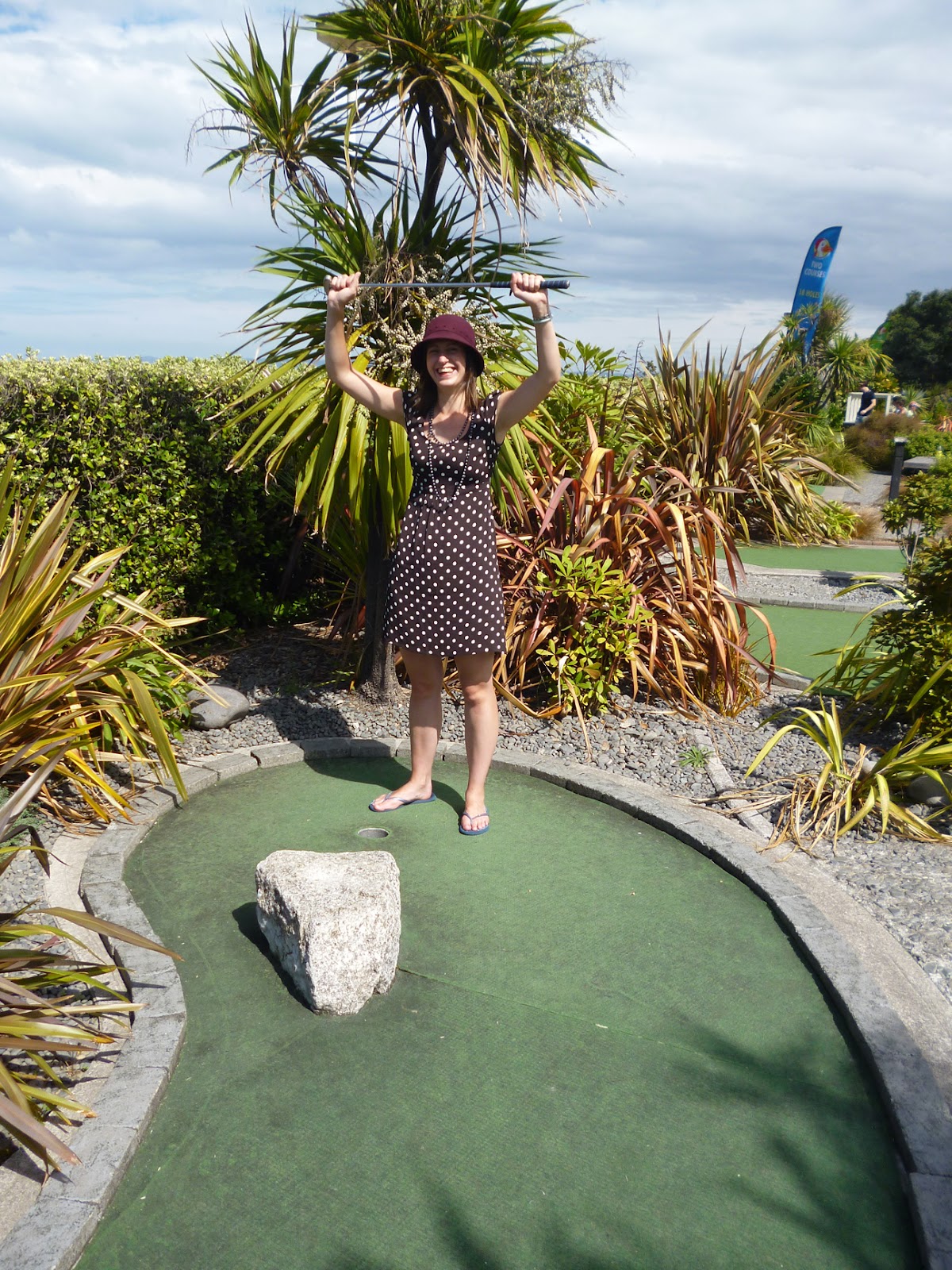
The gauntlet had been thrown down for a rematch on the Par 2 Mini Golf after my victory yesterday. This time Deco Drive would be the course to tee-off on. It was much more challenging as it got the better of me and Lizzie was handed victory by a clear 12 strokes! It was a bitter pill to swallow.

Hole in one!

The undisputed winner of Deco Drive


Walking back through the parade we caught the very end of the Gatsby Picnic with the various themed gazebos on the Marine Parade Gardens. However, the celebrations were all winding down for this year but as with anything, all good things must come to an end...

The Pania of the Reef statue at the start of the Gatsby Picnic


That's all folks!


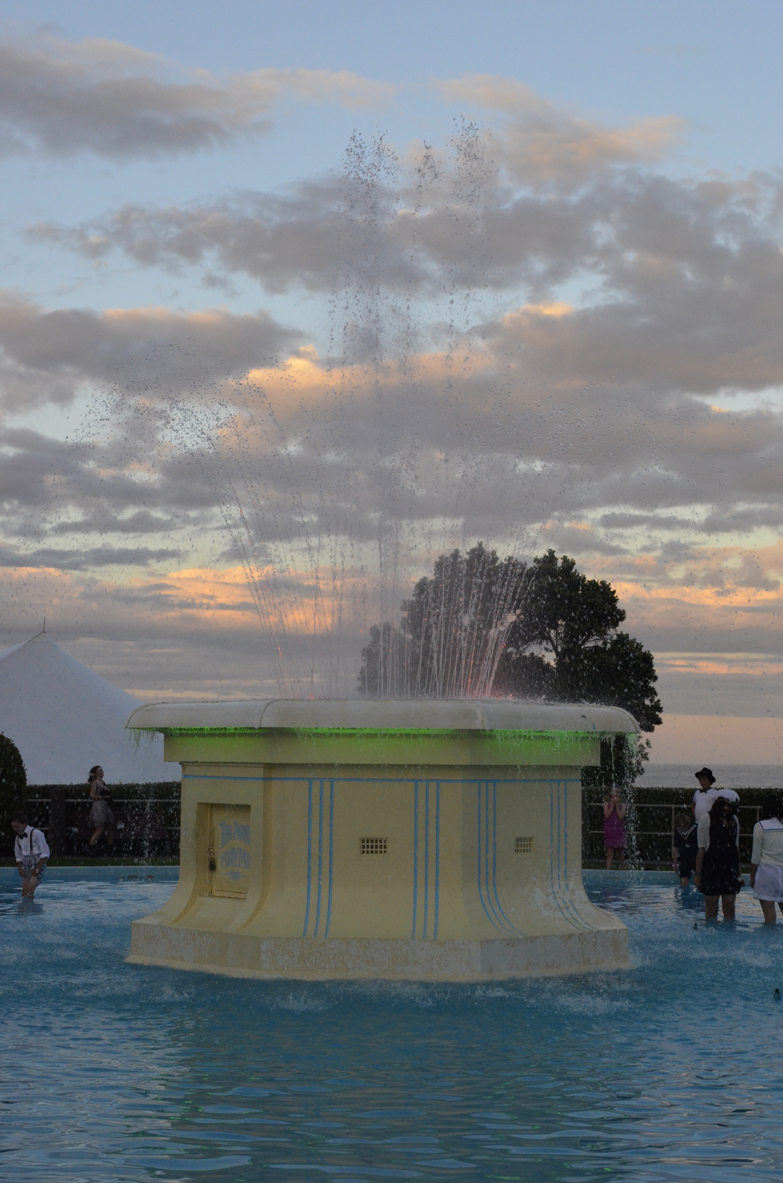
The sun sets on another Art Deco Weekend, until next year